
Blog Details
- Member
- November 24, 2026
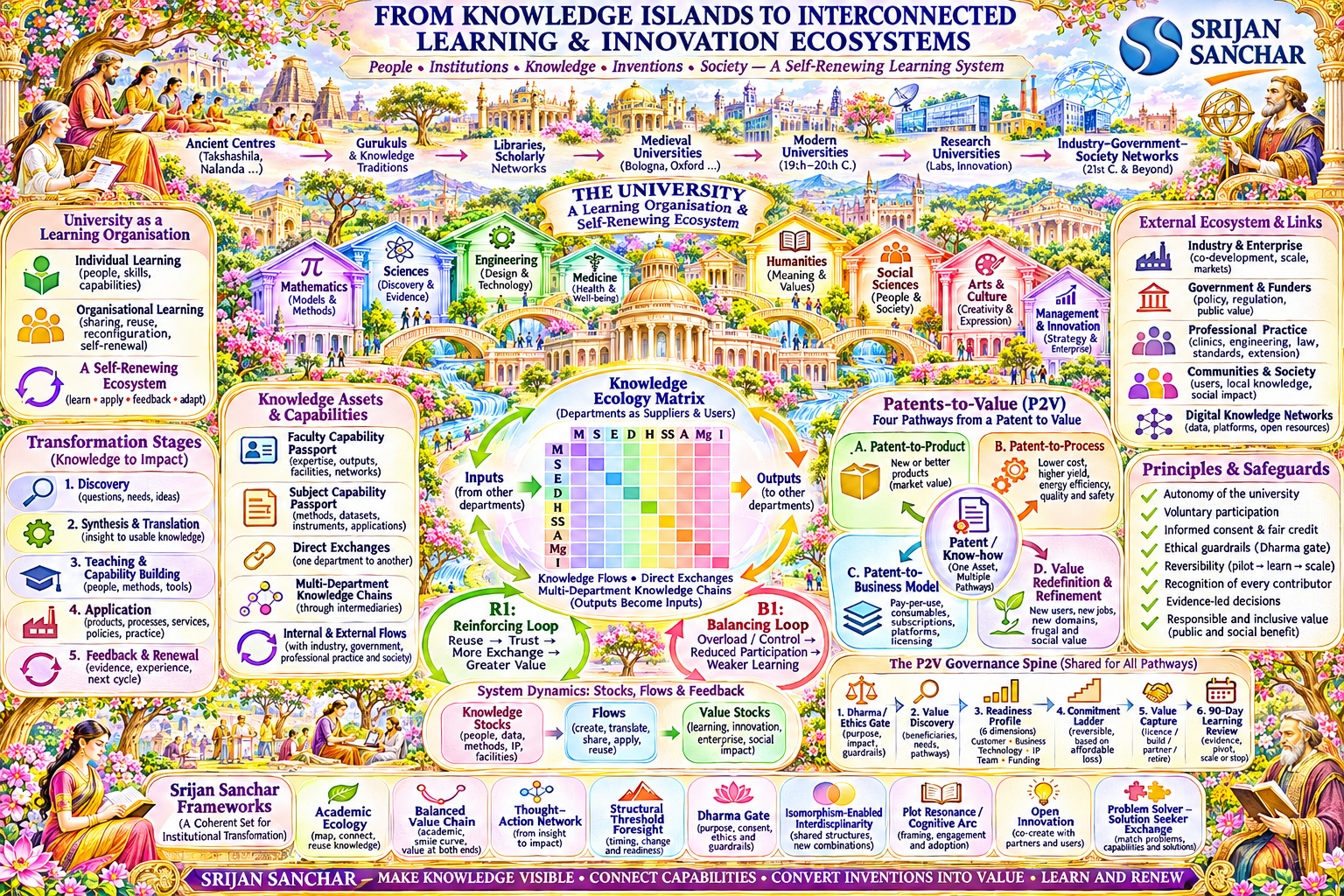
Universities as Learning Systems
Are universities learning organisations, should they become one,
and can they?
Working draft for review | 24
November 2026 | Applies Srijan Sanchar frameworks
1. Question and short answer
This note asks
three things. Is a university, as it typically runs today, a learning
organisation? Is it desirable for universities to become one? And is it
feasible? It judges the first against a published model of the learning
organisation, and the second and third with frameworks from Srijan Sanchar. It
then separates what those frameworks added from what an ordinary analysis would
already say. The note is general: it is not about any one institution.
Short answer
•
Not by default. Universities are strong at
individual learning (research, teaching, scholarship) and weak at learning
about themselves: how they teach, run and decide. A few small studies score
particular institutions as learning organisations, but the evidence base is thin.
•
Desirable, if governed as learning and not as
control. The Dharma gate (section 3) asks first whether the aim is to help
people reuse knowledge or to measure and rank them, and requires guardrails
before any rollout.
•
Feasible in stages and in parts. The workable
target is the stages that convert knowledge into value (synthesis, teaching,
application, feedback). Discovery should stay free, and a whole-university
transformation is not advisable.
•
Timing cannot be stated, but it can be diagnosed. Structural
Threshold Foresight reads the stage of legitimacy decay in an institution
instead of giving a calendar horizon.
•
The frameworks added eleven insights a plain
analysis did not give (section 7), and confirmed several points it did. Some
are applications of a framework by this note’s author, not claims of the source
posts, and are marked.
2. The yardstick: what a learning organisation is
A learning
organisation is one that learns continuously as an organisation, not only
through its individuals, and turns that learning into changed practice. No
single definition is settled and the field disputes which dimensions matter.
This note uses the Watkins and Marsick model, which names seven action
imperatives and offers a questionnaire (the Dimensions of the Learning
Organization Questionnaire) to measure them. The alternatives are Senge’s five
disciplines, Garvin’s building blocks and Marquardt’s systems-linked model.
Two terms
used below. A loosely coupled system is one whose parts act largely
independently, as faculty and departments do in a university. A professional
organisation is one run mainly by highly trained specialists who answer to
their discipline, with wide freedom and weak central control.
3. The Srijan Sanchar frameworks used
Seven
frameworks are used. The table says what each holds and what it is used for
here, so the note can be read without the source posts. Posts are listed under
Sources.
|
Framework |
Core content |
Used here
for |
|
From Islands to a Value Chain: an Internal Competence
Exchange for the University |
Capability islands arise in a loosely coupled system.
Loosely couple discovery, but couple the stages that convert knowledge into
value. Competence matrix with capability and need passports, three-level
matching, expert clinics at existing gates, credit for institutional work,
pull not mandate, small qualitative incentives. A seven-stage chain, with
three stages that have no clear owner |
Anchor model for the transformation; a three-question
screen for any proposed move |
|
Perspective on Social
Transformation |
Derived through RISE,
PAC and PKM. A recurring triangle of external validator, interpreter class
and population. The interpreter class becomes the establishment and sets up
the next transformation. A transformation completes when a new triangle
stabilises. AI may make interpretation automatable |
Structural reading of
resistance, and of the role a university plays |
|
Structural Threshold Foresight |
Anticipates threshold crossings that restructure a domain.
Tracks what is suppressed and whether the suppression holds. Flows that
concentrate increase brittleness. A legitimacy decay clock with stage
horizons. Scenario architecture of two or three stable states, each with
rules, flows and a legitimacy mechanism |
Timing diagnostic, and the shape of the end states |
|
Plot Resonance
Framework with the Cognitive Arc Method |
Four plots; the
Transformation Spiral (up, down, up) justifies disruptive change. The
Cognitive Arc Method maps whether the audience’s thinking followed the
intended arc, including reflective loops |
Narrating the change,
and a measure of reflective learning |
|
Evolution of Open Innovation |
Progression from suggestion schemes to crowdsourcing to the
extended enterprise to Very Large Scale Innovation |
A staged ladder for connecting a university to its
environment |
|
Problem
Solver–Solution Seeker Exchange v4.0 |
Frameworks held as
hypotheses. A 5×5 method with a Transform row and PAC operators; a pattern
from object to relation to network to dynamic transformation, not
independently validated |
Representation shift:
describe the university as dynamics, not a static state |
|
MOSAIC |
One anchor model; other models inform but do not redefine
it. A contradiction between models is a signal of a transition zone, stress
or a hidden variable |
Treating a conflict between models as a locator of the
stage boundary |
Four further
frameworks were applied from short descriptions, because their posts could
not be read in full: the Dharma gate (a moral and ethical test applied before
any initiative, with guardrails set before misuse is imagined), the Knowledge
Ecology Matrix (producers, intermediaries and consumers of knowledge, and the
flows between them), the Balanced Value Chain (value sits at both ends of a
chain, not only one), and the Thought–Action Network (actions graded by how
reversible they are). Results that depend on them should be read with that
limit.
4. Are universities learning organisations?
4.1 A typical university against the seven imperatives
Ratings are the
author’s judgement, not measurements.
|
Imperative |
Typical
university |
Rating |
|
Continuous learning opportunity |
Strong for individuals (research, teaching, development
programmes); rare for learning how the institution runs |
Strong |
|
Inquiry and dialogue |
Debate and peer review
are native; dialogue about administration and teaching practice is thin |
Mixed |
|
Collaboration and team learning |
Disciplinary silos and individual credit (single-author
work, personal promotion) work against it |
Weak |
|
Systems to capture and
share learning |
Outputs (papers,
degrees) are recorded; how-to knowledge such as course design and lab
practice stays with individuals |
Weak |
|
Empowerment toward a shared vision |
Faculty autonomy is high but aimed at individual goals, not
a shared one |
Mixed |
|
Connecting to the
environment |
Strong ties to the
scholarly community, weaker ties to local employers and communities;
accountability reporting can crowd out learning |
Mixed |
|
Strategic leadership for learning |
Rotating leaders, rarely chosen or trained for learning |
Weak |
4.2 Commonalities and differences
Commonalities.
Both are organised around knowledge work and inquiry, both depend on people
as the core asset, and both must adapt as their environments change.
Differences
that matter.
•
Goals: the model assumes a shared vision, while
universities are professional organisations with wide freedom and loose control
over productivity, and teaching, research and service pull in different
directions.
•
Loyalty: staff owe more to their discipline than
to the institution, which weakens shared mental models.
•
Incentives: individual credit rewards keeping
knowledge to yourself, the opposite of capture and sharing.
•
Feedback: outcomes of teaching show up years
later, so loops are slow.
•
Governance: formal organisation has limits as an
instrument of learning, and national accountability requirements can crowd
learning out with compliance.
4.3 What the evidence says
Empirical
research on organisational learning in colleges is thin, and the studies that
exist lean toward a functionalist view that can reinforce top-down power and
strain relations between faculty and administrators. A study of two Estonian
higher education organisations scored both as learning organisations on the
standard questionnaire (84 respondents), so positive cases exist. Universities
have also moved from loosely coupled systems toward strategic organisational
actors, which may make the leadership imperative easier over time.
Conclusion. Partly.
Universities are learning institutions in the individual sense and, by default,
only weakly learning organisations in the organisational sense.
5. Desirability
•
Intent. A learning organisation built to measure
and rank staff fails the Dharma gate. One built so people can reuse each
other’s knowledge and stop repeating effort passes.
•
Who gains. Students, because outcomes feed back
into teaching; faculty, through less reinvention; the institution; and its
communities.
•
Who could be hurt. Faculty autonomy, quieter
units, and anyone whose work the metrics undervalue.
•
Guardrails, set first. Voluntary participation;
a unit consents before any flow it supplies is shared; no individual ranking;
units see and correct their own data; no metric touches pay or promotion
without a separate review.
•
Feedback loop. Learning needs feedback from
consumers of knowledge back to producers. The weakest link is the intermediary
layer: industry liaison, incubation, placement and regulators.
6. Feasibility
6.1 By imperative
|
Imperative |
Feasibility
now |
First
reversible move |
|
Continuous learning |
Easy |
Short learning review after each cross-unit project |
|
Inquiry and dialogue |
Easy |
Regular cross-unit
forums where units present needs and offers |
|
Team learning |
Moderate |
Cross-unit pairs for joint work, chosen by complementary
strengths |
|
Capture and share |
Moderate |
Shared catalogue of
methods and datasets, and a common proposal template |
|
Empowerment, shared vision |
Hard |
Units co-write their own priorities before any
institution-wide vision |
|
Connect to environment |
Moderate |
Feed employer and
industry signals into planning through intermediaries |
|
Strategic leadership |
Hard |
Name a leadership sponsor who also holds the timing
question |
6.2 Commitment by reversibility
•
Explore now (reversible): a baseline
questionnaire, learning reviews, shared catalogues and templates.
•
Pilot (partly reversible): credit for
contributions within a bounded group, and cross-unit pairs.
•
Avoid until the threshold stage is clearer: changing
promotion rules, restructuring departments, or institution-wide metrics tied to
pay.
Verdict. Desirable
under guardrails, feasible in stages, and not advisable as a whole-university
transformation.
7. What the frameworks added to a plain analysis
7.1 The plain baseline
Without
frameworks the conclusion would be: universities are strong on individual
learning and weak on organisational learning; silos, individual credit and goal
ambiguity are the barriers; the change is desirable if it is not turned into
control; and it is feasible through small, reversible steps.
7.2 Eleven insights from the frameworks
Status: New
means the plain analysis did not contain it. Sharpened means the plain analysis
had a weaker version. Applied here means the note’s author applied a framework
in a way its source post does not itself claim.
|
# |
Insight |
Source |
Status |
How to test |
|
1 |
The cut line is by chain stage, not by unit. Team learning
and shared vision suit conversion stages (synthesis, teaching, application,
feedback) and harm discovery |
Islands to a Value Chain |
New |
Tag outputs by stage; see where coupling helps or harms |
|
2 |
The missing piece is a
demand signal. Both ends of a researcher’s chain sit outside the institution
and citation measures uptake by peers, so internal demand leaves no trace |
Islands to a Value
Chain |
New |
Trial a light record
of who used whose method or course |
|
3 |
Need cannot just be asked for. People do not know what
competence they lack, so demand must be surfaced by audits and clinics at
existing gates |
Islands to a Value Chain |
New |
Run a methodological audit; compare with a survey |
|
4 |
Resistance is
structural. The interpreter class becomes the establishment, so faculty and
leaders are structurally the ones who resist, and should not be the only
sponsors |
Social Transformation |
Sharpened |
Check whether reform
stalls where incumbents sponsor it alone |
|
5 |
The threat is wider than failing to learn: if
interpretation is automated, what fills the gap between validators and
learners? A transformation completes when a new triangle stabilises |
Social Transformation |
New (applied here) |
Track which tasks of interpretation are being automated |
|
6 |
A shared vision can
harden into an exclusive identity. Frame it universally to avoid
us-versus-them between units |
Social Transformation,
Dharma gate |
New (applied here) |
Watch whether vision
language divides or includes |
|
7 |
Timing is a diagnostic. Private defection with public
compliance means a long horizon; rising enforcement costs and compliance gaps
mean a short one. Concentrated flows make the system brittle. End states are
defined by what legitimates them |
Structural Threshold Foresight |
Sharpened |
Sense legitimacy decay stage in a sample of institutions |
|
8 |
The middle is where
learning happens and is being hollowed out. Value sits at both ends, and AI
may remove the middle-stage work where knowledge accumulates and diffuses.
Conversion should become orchestration roles |
Balanced Value Chain,
smile curve, outside evidence |
New |
Measure credit and
funding per hour by stage; the shape is contested |
|
9 |
A conflict between models marks the boundary. The
learning-organisation model says empower toward a shared vision while the
Islands paper protects autonomy at discovery; that conflict locates the stage
boundary |
MOSAIC |
New (applied here) |
Check that the boundary holds across disciplines |
|
10 |
Use the right plot to
carry the change. A constant-improvement story fits poorly when change has a
cost; the Transformation Spiral acknowledges past success and the necessary
struggle. The Cognitive Arc Method can check whether thinking followed the
arc |
Plot Resonance
Framework |
Sharpened |
Compare intended and
actual arcs after a briefing |
|
11 |
Staging, and the university as dynamics. Internal feedback
comes first and external partnership third. Measure change in flows over
time, not a static score |
Open Innovation evolution, Problem Solver–Solution Seeker
Exchange |
Sharpened |
Compare flows between two time points |
7.3 What the frameworks only confirmed
•
Incentives and credit matter, and stakes should stay
small and reversible.
•
Opt-in works better than mandates.
•
Guardrails come before rollout.
•
Hub units can be overloaded, so capacity must come with
the request.
7.4 The academic smile curve, as a hypothesis
In
manufacturing, the smiling curve (attributed to Stan Shih) shows value highest
at the two ends of the chain, design and brand or service, and lowest in the
middle, assembly. Insight 8 carries this over to academia by analogy: credit
would be high where questions are framed and where results are translated into
use, and low in the routine middle. This is the author’s analogy and not a
published academic result. Outside evidence on the shape is mixed: one 2026
paper argues AI deepens the smile, while an analysis of manufacturing finds the
middle rising and the curve flattening. In lab-dependent fields the middle may
be higher. It should be tested, not assumed.
8. Limits of this note
1.
Confirmation risk. The frameworks were applied
after a plain view had been formed and scored by the same analyst, so some
agreement is expected. A stronger test would apply the frameworks first, or
have an independent reviewer score them.
2.
Hypothesis status of the sources. The Problem
Solver–Solution Seeker Exchange labels its effects as hypotheses and says its
engine has not been independently validated. The Islands paper is a position,
and its benchmark figures are self-reported by the programmes cited.
3.
Applications are not the posts’ claims. Insights
5, 6 and 9 are applications by the author, and parts of 8 and 10 go beyond what
the posts say.
4.
Frameworks not read in full. The posts on the
Balanced Value Chain, the New Smile Curve, the Thought–Action Network and
Knowledge Organizations in Five Domains were seen by title or snippet only.
They may refine or contradict the academic smile curve in section 7.4.
5.
No calendar horizon. Any period such as
"five to ten years" would be a placeholder. The timing claim here is
a diagnostic, not a forecast.
6.
Judgement-based ratings and thin evidence. The
imperative ratings are judgements, and the higher education literature on
organisational learning is small and mostly functionalist.
9. Next steps and tests
1.
Tag research and teaching outputs by chain stage and
measure credit and funding per hour, to test the smile shape and insight 8.
2.
Trial a light internal uptake record of who used whose
method, course or insight, to test insight 2.
3.
Run the learning-organisation questionnaire as a
baseline, and add a Cognitive Arc check, to measure reflective learning as well
as scores.
4.
Sense the legitimacy decay stage in a small sample of
institutions: private cynicism with stable compliance, or rising enforcement
costs and compliance gaps.
5.
Apply the Islands paper’s three-question screen to
practices an institution has already adopted: does it couple conversion or
discovery, is it pull or mandate, and are personal stakes low enough to avoid
gaming.
6.
Read the four posts not yet read in full and reconcile
the academic smile curve with them.
Sources
Srijan
Sanchar posts
•
From Islands to a Value Chain: An
Internal Competence Exchange for the University
•
Srijan Sanchar Perspective on Social
Transformation
•
Structural Threshold Foresight
•
Method for Framing Leadership Stories
(Plot Resonance Framework)
•
Multi-model Orchestration System for
Analytical Intelligence and Convergence
•
Srijan Sanchar Leading the Evolution of
Open Innovation
•
Problem Solver Solution Seeker Exchange
Outside
sources
•
Watkins and Marsick, Sculpting the
Learning Organization (overview)
•
Synthesis of learning organization
models
•
Organizational learning in higher
education (Springer)
•
Is the higher education institution a
learning organization?
•
Are today’s universities still able to
learn? (EUA)
•
Nothing to Smile About (Journal of
Economic Issues, 2026)